Explore GLP-3 Retatrutide Research
| Medical and terminology notice: “GLP-3 peptide” is not the formal name of a naturally occurring third GLP hormone or an established medication class. The term is commonly used online for triple-receptor agonists such as investigational retatrutide. This article is educational, not medical advice, and does not provide dosing or purchasing guidance. |
Quick Answer
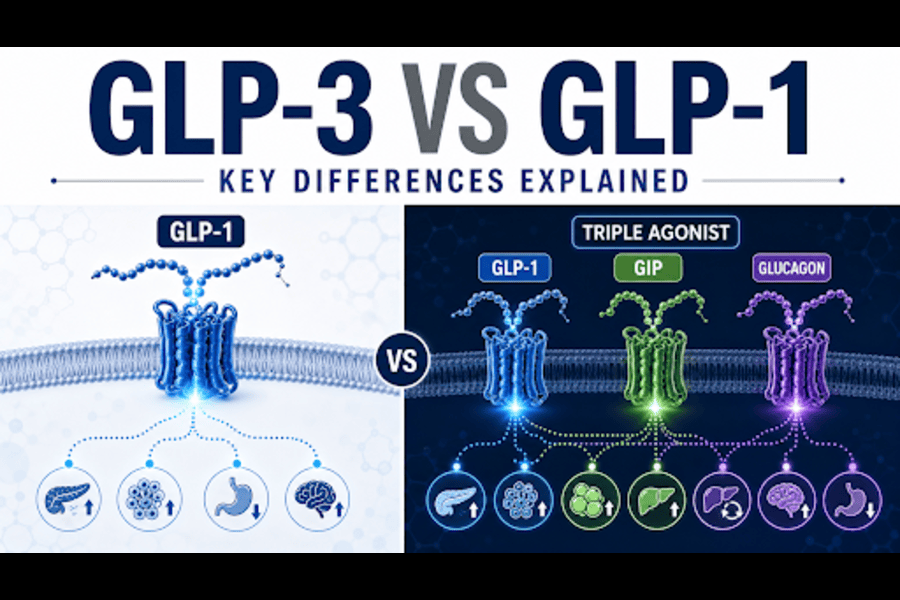
GLP-1 and the product category often called “GLP-3” are not equivalent terms. GLP-1 is a naturally occurring incretin hormone, and GLP-1 receptor agonists are a well-defined medication class with multiple approved drugs. “GLP-3 peptide” is an informal marketing label usually used for a triple agonist that activates three receptors: GLP-1, glucose-dependent insulinotropic polypeptide, or GIP, and glucagon.
Retatrutide is the best-known triple agonist fitting that description. It has produced substantial weight reduction in clinical trials, but it remains investigational and is not approved by the FDA or any other regulatory agency as of July 2026. GLP-1 receptor agonists, by contrast, include approved medicines with established labels, manufacturing controls, clinical guidance, and postmarketing safety monitoring.
Is GLP-3 a Real Peptide?
The phrase “GLP-3 peptide” can be misleading. Human physiology includes glucagon-like peptide-1 and glucagon-like peptide-2, but “GLP-3” is not the standard name of a recognized human incretin hormone. Online sellers and commentators often use GLP-3 as shorthand for a compound with three metabolic receptor targets. The “3” refers to three receptor actions, not a third member of the glucagon-like peptide family.
In most current discussions, GLP-3 refers to retatrutide, also known by the development code LY3437943. Retatrutide is a single engineered peptide designed to activate the GLP-1, GIP, and glucagon receptors. Scientific papers call it a triple-hormone-receptor agonist, triple receptor agonist, or triagonist. Calling it GLP-3 may be convenient for search and marketing, but it is less precise.
GLP-3 vs GLP-1 at a Glance
| Category | GLP-1 | “GLP-3” / triple agonist |
| Meaning | A natural incretin hormone and an established receptor target | Informal label for one peptide acting at three receptors |
| Primary targets | GLP-1 receptor | GLP-1, GIP, and glucagon receptors |
| Example | Semaglutide or liraglutide | Retatrutide |
| Regulatory status | Several approved medicines exist | Retatrutide remains investigational and unapproved |
| Evidence base | Large clinical programs and postmarketing experience | Promising Phase 2 and Phase 3 trial data; development continues |
| Main research idea | Appetite, glucose-dependent insulin signaling, and gastric emptying | Combine appetite and glucose effects with additional metabolic signaling |
| Availability | Prescription products for approved indications | Legally available only through authorized clinical trials |
How GLP-1 Works
GLP-1 is released from intestinal cells after food intake. It helps coordinate the post-meal response by increasing insulin secretion when glucose is elevated, suppressing inappropriate glucagon release, slowing gastric emptying, and signaling satiety through the nervous system. Natural GLP-1 is rapidly broken down, so drug developers created longer-acting receptor agonists that reproduce selected GLP-1 effects over a longer period.
Approved GLP-1 receptor agonists include medications used for type 2 diabetes, chronic weight management, or other labeled indications. Individual products are not interchangeable. Their approved uses, strength, schedule, cardiovascular evidence, contraindications, warnings, and delivery formats differ. A clinician chooses among them based on the patient, the product label, access, and medical history.
How a “GLP-3” Triple Agonist Works
A triple agonist attempts to coordinate three receptor systems in one molecule. GLP-1 receptor activity supports glucose-dependent insulin secretion, satiety, and slower gastric emptying. GIP receptor activity adds another incretin signal and may complement insulin and metabolic responses. Glucagon receptor activity is more complex: glucagon can raise blood glucose, but receptor activation may also influence energy expenditure, lipid metabolism, and substrate use.
The design challenge is balance. Too much activity at one receptor could reduce tolerability or undermine another effect. An engineered peptide must have the right potency, duration, receptor profile, and exposure. Retatrutide was designed with this balancing problem in mind, but its final benefit-risk profile cannot be determined from receptor theory alone. That requires large controlled trials and regulatory review.
Effectiveness: What the Research Shows
GLP-1 receptor agonists
GLP-1 receptor agonists have been tested across large clinical programs. Depending on the specific medication and indication, studies have shown improvements in blood-glucose control, body weight, and selected cardiovascular or kidney outcomes. These results belong to individual approved products, populations, and doses. “GLP-1” should not be treated as one uniform result that applies identically to every drug.
Retatrutide and triple agonism
In a Phase 2 trial published in the New England Journal of Medicine, adults with obesity who received the highest studied retatrutide maintenance dose had a mean body-weight reduction of 24.2% after 48 weeks. Gastrointestinal events were the most common side effects, and discontinuation due to adverse events occurred more often in retatrutide groups than in placebo. The trial was designed to test retatrutide, not a generic category of products labeled GLP-3.
Lilly announced topline Phase 3 TRIUMPH-1 results in May 2026, but retatrutide remains under clinical development. Topline announcements and even successful trials do not equal regulatory approval. Regulators still evaluate the complete evidence package, manufacturing controls, labeling, and the balance of benefits and risks.
Side Effects and Safety Differences
Both GLP-1 receptor agonists and investigational triple agonists can produce gastrointestinal effects. Nausea, vomiting, diarrhea, constipation, abdominal symptoms, and reduced appetite have appeared in clinical research. The frequency and severity depend on the specific compound, exposure, titration approach, and patient. Retatrutide trials reported gastrointestinal events most often during dose escalation and more frequently in higher-dose groups.
Approved GLP-1 medicines have product-specific warnings and precautions that clinicians can review in official prescribing information. They also have regulated manufacturing and established pharmacovigilance systems. Retatrutide does not yet have an approved label defining indications, dosing, contraindications, warnings, or monitoring. Its long-term safety profile is still being characterized in Phase 3 research.
A product sold online as “GLP-3,” “reta,” or “research retatrutide” should not be assumed to match clinical-trial material. The FDA states that retatrutide cannot be used in compounding under federal law, has not been found safe and effective for any condition, and is not a component of an FDA-approved drug. The agency has also warned about products falsely labeled for research use while being marketed to consumers.
Approval and Availability
This is the clearest practical difference. Several GLP-1 receptor agonists are approved prescription medicines. Their manufacturers must meet product-specific standards for identity, strength, quality, purity, labeling, and ongoing safety reporting. Patients receive them through regulated medical channels for approved uses or under a clinician’s legally permitted prescribing judgment.
Retatrutide is not approved. Lilly states that it is legally available only through its sponsored clinical trials and warns people not to take anything claiming to be retatrutide outside those trials. A vendor’s use of “GLP-3 peptide” does not create a legitimate approved category or make an experimental product equivalent to the material used in a clinical trial.
Why Triple Agonists May Produce Different Results
- They activate three receptor systems rather than one.
- Glucagon-receptor activity may add effects on energy use and lipid metabolism.
- GIP and GLP-1 signaling may complement each other in glucose and appetite regulation.
- The receptor balance can change both effectiveness and tolerability.
- Results depend on the exact engineered molecule, not merely the phrase “triple agonist.”
It is tempting to assume that three targets must be better than one. Biology is not that simple. Additional targets introduce additional interactions, and a stronger average trial result can come with more adverse events, uncertain long-term effects, or a different response across patient groups. Direct head-to-head trials are more informative than comparing headline percentages from studies with different designs.
GLP-3 vs GLP-1: Which Is Better?
There is no universal answer. If the question is which has established clinical availability, approved GLP-1 receptor agonists clearly have the advantage. They have completed regulatory review and have official prescribing information. If the question is which research direction has produced the largest average weight reduction in a selected trial, retatrutide’s Phase 2 results are notable. That comparison does not make an unapproved product the better medical choice.
The right treatment decision depends on an approved indication, health history, goals, risks, other medicines, and clinical supervision. An investigational triple agonist should be evaluated through properly conducted trials rather than purchased as a substitute for approved care.
Read more: How Long Does Olanzapine Take to Work for Anxiety, 7 Important Truths for Real Relief
Frequently Asked Questions
Is GLP-3 the same as retatrutide?
GLP-3 is often used online to refer to retatrutide, but it is not retatrutide’s formal scientific name. Retatrutide is a GLP-1, GIP, and glucagon receptor triple agonist.
Is GLP-3 FDA approved?
No medication is approved under a GLP-3 class. Retatrutide remains investigational and is not FDA approved as of July 2026.
Is GLP-3 stronger than GLP-1?
Retatrutide produced substantial average weight reduction in trials, but “stronger” is too vague for a medical comparison. Effectiveness, tolerability, approval status, indication, and patient response all matter.
Is tirzepatide a GLP-3 peptide?
No. Tirzepatide is a dual GIP and GLP-1 receptor agonist. It does not add glucagon-receptor agonism and is not a triple agonist.
Can retatrutide be compounded?
The FDA states that retatrutide cannot be used in compounding under federal law. Products promoted as compounded retatrutide are not FDA approved and should not be assumed safe, effective, or equivalent to trial material.
Final Takeaway
The main difference between GLP-3 and GLP-1 is not simply the number in the name. GLP-1 is a real hormone and an established therapeutic target. “GLP-3 peptide” is informal shorthand for a triple agonist, usually retatrutide, that activates GLP-1, GIP, and glucagon receptors. Triple agonism is a promising research strategy, but retatrutide remains investigational.
Readers should separate published clinical-trial findings from online products borrowing the GLP-3 label. Approved GLP-1 medications have regulated labels and established clinical channels. Retatrutide should remain within authorized clinical trials until regulators complete their review and approve a specific product, if the evidence ultimately supports approval.